

Quick Takeaways
- Seeing demons in dreams often represents fear, inner conflict, guilt, unhealthy influence, or a problem you feel powerless to confront.
- Your emotions, the demon’s behavior, and what happened before the dream are more useful than relying on a fixed symbolic definition.
- A frightening dream does not automatically prove a spiritual attack, predict danger, or reveal that an evil presence is near you.
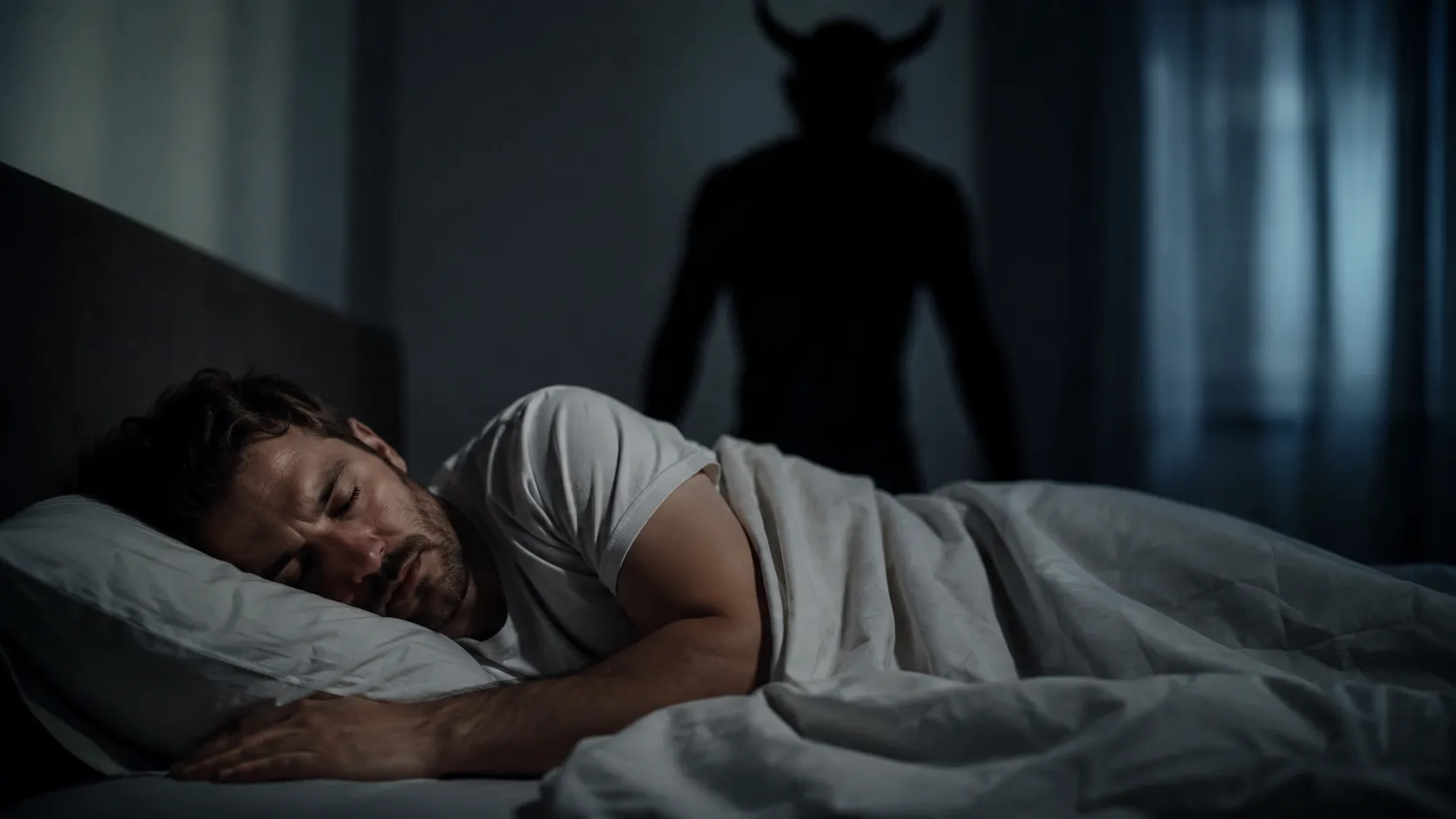
Waking from a dream about a demon can leave you shaken long after the room becomes quiet. You may wonder whether the dream carried a warning, exposed a hidden spiritual problem, or simply reflected stress. The meaning of seeing demons in dreams is rarely found in the image alone. Its significance depends on what the demon did, how you responded, what you felt, and what has been happening in your waking life.
Rather than accepting the most frightening interpretation, approach the dream with curiosity. Demon imagery can be spiritually meaningful, but it can also represent emotional pressure, buried anger, guilt, temptation, trauma, or a part of yourself that you have avoided examining.
What Does Seeing Demons in Dreams Usually Mean?
Seeing a demon in a dream usually symbolizes something you experience as threatening, corrupting, controlling, or deeply disturbing. The figure may represent an external conflict, such as a harmful relationship, or an internal struggle involving fear, shame, resentment, pride, or compulsive behavior.
For example, a person who feels trapped in a controlling relationship might dream of a demon following them through a dark house. Someone struggling with guilt may dream of a demon accusing or watching them. Another dreamer might see a demon guarding a doorway when they are afraid to make a difficult change.
The demon does not necessarily represent a literal being. Dreams often use emotionally powerful images because ordinary symbols would not communicate the seriousness of the issue as clearly.
Kenneth Gray takes this symbolic approach in Dreams: The Magic of the Night. In one of his dreams, a large image of the devil appeared prominently in a library. Gray interpreted the devil as a symbol of ego and egotism, especially his desire for approval, admiration, and personal importance. Instead of treating the dream as proof of an external evil force, he used it to examine the motives influencing his behavior.

Book About Dreams
This book is perfect for anyone seeking to understand the messages and meanings hidden in their dream life. It offers a clear framework for interpreting dreams with real examples and thoughtful insights.
Get the Book- Based on personal dream journals
- Step-by-step interpretations
- Perfect for dream seekers
That interpretation offers an important principle: ask what the demon represents in your life before deciding what the dream means.
Psychological, Spiritual, and Biblical Interpretations
Demon dreams can be viewed through several lenses. These approaches do not always contradict one another. A dream may contain emotional, moral, and spiritual meaning at the same time.
| Interpretive lens | What the demon may represent | Helpful question |
|---|---|---|
| Psychological | Fear, trauma, shame, anger, an unwanted trait, or loss of control | What feeling or truth have I been avoiding? |
| Spiritual | Temptation, harmful influence, separation from personal values, or spiritual fear | What is weakening my peace, faith, or integrity? |
| Biblical or Christian | Deception, accusation, destructive behavior, temptation, or conflict between good and evil | Does this dream call me to prayer, honesty, repentance, or wiser choices? |
| Personal and symbolic | A specific person, memory, habit, environment, or belief associated with danger | What does a demon personally mean to me? |
Psychological Meaning of Seeing Demons in Dreams
From a psychological perspective, the demon may give a face to an emotion that feels too threatening to address directly. It can embody fear, rage, humiliation, jealousy, addiction, self-criticism, or memories that remain emotionally active.
This interpretation is especially relevant when the dream occurs during a period of conflict, exhaustion, grief, or major change. The mind may turn an unclear source of distress into a visible enemy that can be chased, confronted, escaped, or defeated.
Learning about the role of the subconscious mind can help you understand why uncomfortable feelings sometimes appear through extreme dream imagery.
Spiritual Meaning of Seeing a Demon
For spiritually oriented dreamers, a demon may symbolize an influence that feels opposed to peace, truth, compassion, or spiritual growth. It could point to a destructive habit, a manipulative person, a fear-based belief, or a temptation that conflicts with your conscience.
Some people interpret such dreams as warnings to strengthen prayer, set boundaries, or examine the direction of their lives. That response can be constructive when it leads to calm reflection and healthier choices.
Problems begin when every nightmare is treated as proof of supernatural attack. Fear can make a dream feel more authoritative than it is. Before reaching that conclusion, compare the experience with common signs associated with spiritual attack in dreams while remaining open to emotional and sleep-related explanations.
Biblical Meaning of Seeing Demons in Dreams
The Bible includes demons and unclean spirits, but it does not provide a fixed dictionary explaining what every demon dream means. Biblical interpretation should therefore focus less on predicting events and more on the dream’s moral and spiritual effect.
Ask whether the dream exposes deception, pride, fear, temptation, bitterness, or behavior that is pulling you away from your values. A dream that encourages honesty, self-control, compassion, or renewed faith may be more useful than an interpretation built entirely around panic.
Related symbols can also provide context. For instance, the biblical meaning of a witch in a dream may involve fear of manipulation, forbidden influence, spiritual confusion, or distrust.
How the Dream Scenario Changes Its Meaning
The demon’s behavior often reveals more than its appearance.
Being Chased by a Demon
Being chased may suggest that you are avoiding a problem, emotion, memory, or responsibility. The dream can reflect a conflict that continues to follow you because it has not been addressed.
Consider what you were running from before the dream occurred. A delayed decision, unresolved argument, unpaid obligation, secret, or painful memory may be the true pursuer.
Fighting or Defeating a Demon
Fighting a demon can represent resistance, courage, spiritual determination, or an effort to regain control. Winning may show growing confidence, while repeatedly losing may reflect exhaustion or uncertainty about how to handle the issue.
The dream does not guarantee victory over a real-world problem. It may instead show that part of you is ready to confront what you previously avoided.
A Demon Attacking You
An attack can reflect emotional vulnerability, intense stress, criticism, coercion, or feeling overpowered by another person. Pay attention to where the attack happens. A bedroom may relate to privacy or intimacy, while a workplace could point to professional pressure.
Similar themes appear in dreams about monsters trying to kill you, where the threatening figure may symbolize overwhelming fear rather than literal danger.
A Demon Inside Your House
Houses often represent personal life, identity, or the inner self. A demon inside the house may suggest that the problem feels close, private, or deeply rooted.
Different rooms may add meaning. A demon in the basement can suggest something buried or neglected. One in the kitchen may relate to nourishment, family routines, or what you are emotionally taking in. A figure in the bedroom may involve vulnerability, relationships, sexuality, or sleep anxiety.
Being Possessed in a Dream
Dream possession often points to loss of control. You may feel controlled by anger, desire, addiction, fear, social pressure, or another person’s expectations.
Ask what seemed to enter or take over your behavior. The dream may be illustrating how a habit or emotion has begun making decisions for you.
Praying or Calling on God
Praying during the dream may reflect faith, a need for protection, or your attempt to restore inner stability. Feeling calmer after praying can show that your spiritual practices provide a sense of safety and direction.
When prayer has no immediate effect in the dream, it does not mean your faith has failed. It may express frustration, spiritual uncertainty, or the feeling that a difficult situation has continued despite your efforts.
How to Interpret a Demon Dream Step by Step
1. Record the dream before interpreting it
Write down the setting, characters, actions, colors, words, and ending. Include details that seem strange or unimportant because they may later provide the clearest connection to waking life.
Do not begin with “This was a spiritual attack.” Beginning with a conclusion can cause you to overlook other possibilities. A consistent method for remembering dreams more clearly can make your interpretation more reliable.
2. Identify the strongest emotion
Was the central feeling fear, disgust, guilt, anger, helplessness, or determination? The emotional tone is often more revealing than the demon’s physical form.
A frightening figure accompanied by curiosity may have a different meaning from the same figure accompanied by shame.
3. Describe the demon in ordinary language
Replace the word “demon” with its qualities. Was it deceptive, controlling, seductive, violent, accusing, watchful, or impossible to escape?
Then ask where those qualities currently appear in your life. They may describe another person, but they may also describe your own behavior or inner dialogue.
4. Review the previous day
Dreams frequently draw from recent conversations, media, worries, and emotional experiences. Horror films, religious discussions, frightening videos, arguments, and stressful news can influence dream content.
Look for a recent trigger before assigning a deeper meaning. A trigger does not necessarily make the dream meaningless. It may simply explain why the mind selected demon imagery.
5. Connect the dream to a current conflict
Complete this sentence: “The demon reminds me of…”
Write the first honest answer that comes to mind. It might be a person, habit, memory, fear, temptation, or part of yourself that you dislike.
6. Decide what practical response is appropriate
A useful interpretation should lead to a grounded response. You might need to set a boundary, apologize, rest, pray, speak with someone, reduce frightening media, address a habit, or seek professional support.
Avoid making major life decisions based only on one dream. Look for patterns across several dreams and compare them with observable events in waking life.
Could It Be a Nightmare or Sleep Paralysis?
Not every frightening nighttime experience is a symbolic dream. Nightmares may be associated with stress, traumatic experiences, illness, some medications, substance use, or disrupted sleep. Frequent nightmares can also occur with post-traumatic stress and other conditions, although one demon dream does not establish any diagnosis.
Sleep paralysis is another possibility when you feel awake but cannot move. During these episodes, vivid dreamlike hallucinations may include a frightening figure, pressure, sounds, or the sense that someone is present in the room.
The experience can feel supernatural because awareness returns before normal muscle control does. If episodes happen repeatedly, disrupt your sleep, cause fear of going to bed, or occur with severe daytime sleepiness, discuss them with a healthcare professional.
When to Seek Additional Support
Consider professional support when demon dreams happen frequently, recreate traumatic experiences, interfere with daily functioning, or cause persistent anxiety. A licensed mental health professional can help you explore emotional triggers without dismissing your spiritual beliefs.
A physician or sleep specialist may be appropriate when the episodes include repeated paralysis, injuries from acting out dreams, breathing problems, extreme daytime sleepiness, or hallucinations while fully awake.
Spiritual guidance can also be helpful when it comes from a calm, trustworthy person who respects both faith and mental health. Be cautious with anyone who uses your fear to demand money, isolate you from support, or claim certainty about supernatural danger.
Understanding the Meaning of Seeing Demons In Dreams
This is not automatically a prediction, visitation, or sign that something evil is pursuing you. The demon may represent fear, ego, guilt, temptation, harmful influence, unresolved trauma, or a situation that has gained too much control over your attention.
Treat the dream as an invitation to examine your inner and outer life honestly. Record what happened, identify the strongest emotion, connect the demon’s behavior with current circumstances, and choose a practical response. For a broader method of studying symbols without relying on rigid definitions, explore the principles of personal dream interpretation.
Frequently Asked Questions
Does seeing a demon in a dream mean a real demon visited me?
A dream alone cannot confirm that a real demon visited you. Psychological stress, religious beliefs, frightening media, sleep paralysis, and personal symbolism can all produce demon imagery, so consider several explanations before concluding.
What does it mean when a demon chases you in a dream?
A chasing demon often represents a fear, responsibility, memory, or conflict you have been avoiding. The meaning becomes clearer when you identify what was happening in your life before the dream and why escape felt necessary.
What is the biblical meaning of fighting demons in a dream?
From a biblical perspective, fighting a demon may symbolize resistance to temptation, destructive behavior, fear, or spiritual discouragement. It can encourage prayer and moral reflection, but it should not be treated as guaranteed evidence of literal spiritual warfare.
Why do I keep having recurring dreams about demons?
Recurring demon dreams may continue because the underlying emotion or conflict remains unresolved. Keep a dream journal, review stress and sleep patterns, and seek professional guidance when the dreams are frequent, trauma-related, or seriously affecting your well-being.
What does it mean when I rebuke a demon in a dream?
Rebuking a demon may reflect your desire to reclaim authority, protect yourself, or reject an influence that conflicts with your beliefs. Your feelings after the confrontation can indicate whether you are gaining confidence or still feel threatened by the waking-life issue.
