

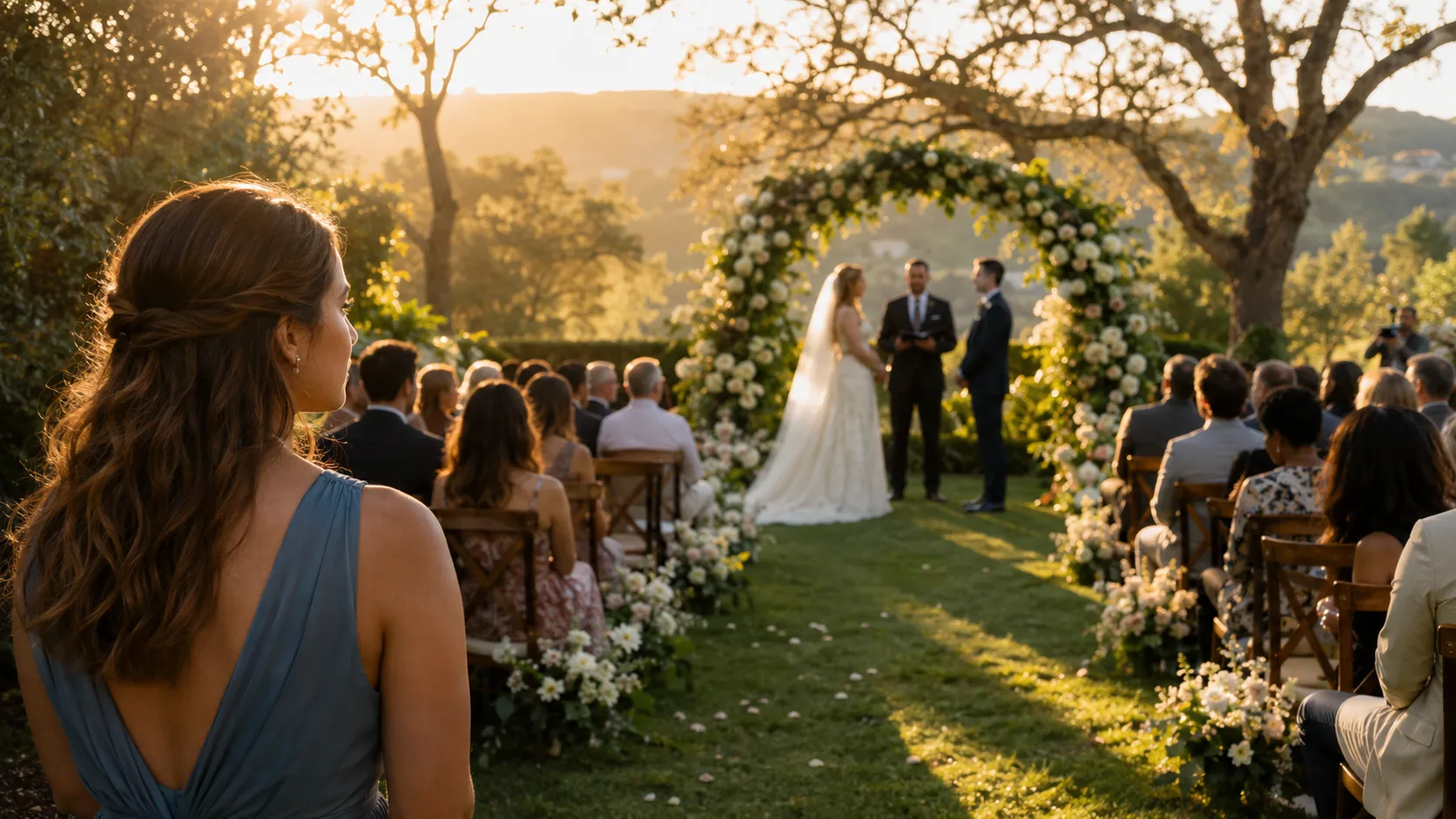
Explore how your role, emotions, and relationships shape this meaningful dream image.
You are sitting among wedding guests, watching two people exchange vows, when something about the scene stays with you after waking. The spiritual meaning of attending a wedding in a dream may involve connection, commitment, inner harmony, or your response to change, but there is no single meaning that applies to everyone.
Being a guest gives the dream a particular angle: you are witnessing a union and deciding, consciously or otherwise, how you feel about it. Before treating the wedding as a sign of what comes next, consider who was getting married, whether you felt welcome, and what weddings mean in your own life.
Understanding the Spiritual Meaning of Attending a Wedding in a Dream
A wedding brings several ideas into one setting: promises, relationships, celebration, family expectations, and a change in social roles. A spiritual interpretation can use these ideas as prompts for reflection.
For example, a peaceful wedding might invite you to consider where you feel connected or ready to support a new beginning. An uncomfortable ceremony might bring up questions about belonging, obligation, or a commitment you do not fully accept.
Dream interpretation resources commonly discuss weddings through themes of union and personal change. The Centre of Excellence also distinguishes attending another person’s wedding from getting married yourself, suggesting that the guest’s role can invite reflection on relationships and support for others. These are interpretive possibilities rather than established meanings. Centre of Excellence
The most useful question is therefore more specific than “What does a wedding symbolize?” Ask: “What did attending this particular wedding feel like to me?”
Connection and belonging
If you felt welcomed, the wedding could serve as a personal image of belonging. Perhaps you are becoming more comfortable in a community, reconnecting with relatives, or allowing yourself to receive support.
From a spiritual perspective, you might understand that feeling as gratitude for shared life or an invitation to participate more fully in relationships.
If you felt invisible or excluded, consider a different possibility. The dream might provide a way to explore where you want recognition or connection. It does not establish that anyone secretly dislikes you.
Commitment beyond romance
Watching other people make promises can bring your own commitments into focus.
Those commitments might involve a relationship, but they could also concern a creative project, a faith practice, a family responsibility, or a decision about how you want to live.
A useful reflection is: “Which promises feel meaningful to me, and which ones am I maintaining mainly because other people expect them?”
The wedding setting gives that question emotional weight without supplying the answer.
Inner harmony
One symbolic reading treats the couple as an image of two parts of your life coming together.
You might be trying to combine independence with closeness, ambition with rest, or practical responsibilities with spiritual interests. In this reading, attending the wedding could represent observing that process rather than feeling fully settled within it.
This interpretation is most useful when you can identify a real tension in your waking life. Without that connection, “inner harmony” can become a pleasant phrase that explains very little.
Accepting someone else’s transition
A wedding changes relationships beyond the couple. Friends and relatives may need to adjust to new priorities, routines, or responsibilities.
As a reflection exercise, consider whether someone close to you is entering a new stage of life. Your dream could help you examine your response: happiness, uncertainty, pride, sadness, or several feelings at once.
Supporting another person’s growth does not require you to feel uncomplicated joy about every change.
Why Does Being a Wedding Guest Matter?
Attending a wedding and getting married in a dream create different questions.
As a guest, you may be watching a commitment, supporting someone, joining a community, or feeling outside an important event. The central concern could be your relationship to what is happening rather than a promise you are making yourself.
Look closely at your actions.
Were you applauding, searching for your seat, helping with preparations, or standing near the exit? Each action offers a different starting point for reflection.
Helping throughout the celebration might prompt you to examine how much responsibility you take for other people’s happiness. Searching for a seat could lead you to consider where you feel uncertain about your place. Leaving willingly might raise questions about boundaries.
These are questions to test against your experience. A dream action doesn’t diagnose your personality or reveal another person’s intentions.
For a broader approach to exploring symbols, emotions, and context, consider this introduction to personal dream interpretation.

Book About Dreams
The Magic of the Night
This book is perfect for anyone seeking to understand the messages and meanings hidden in their dream life. It offers a clear framework for interpreting dreams with real examples and thoughtful insights.
Get the Book- Based on personal dream journals
- Step-by-step interpretations
- Perfect for dream seekers
What Research Can Explain About Wedding Dreams
Spiritual interpretation asks what a dream might mean within your beliefs. Dream research asks different questions, including how waking experiences appear in dream content.
A study by Michael Schredl and Friedrich Hofmann examined the relationship between waking activities and dream activities. Its findings supported connections between waking life and dreaming, while also showing that different activities are incorporated differently and that broad explanations need refinement. It did not establish a fixed meaning for wedding dreams. PubMed
Applied cautiously, this suggests checking ordinary context before looking for a spiritual message. Have you recently attended a wedding, received an invitation, discussed marriage, or watched wedding-related content? Those experiences provide plausible material for the dream.
Science has not settled the purpose of dreaming. The National Institutes of Health notes that scientists remain uncertain about why we dream, and that dreams can occur during both REM and non-REM sleep. nichd.nih.gov
You can explore a dream spiritually while acknowledging those limits. Personal meaning and scientific explanation answer different questions.
For more background, explore why we dream.
How Your Feelings Change the Interpretation
The ceremony’s appearance is only one part of the dream. A beautiful wedding can feel lonely, while a simple gathering can feel deeply welcoming.
Use the following table as a reflection guide. The possibilities are prompts, not a dictionary of guaranteed meanings.
| Dream experience | Possible theme to explore | Useful question |
|---|---|---|
| You feel welcomed and relaxed | Belonging or acceptance | Where do I feel supported right now? |
| You celebrate wholeheartedly | Gratitude or support for change | Whose progress am I happy to witness? |
| You feel sad during the celebration | Longing, loss, or mixed feelings | What does this event remind me I miss? |
| You cannot find your seat | Uncertainty about your place | Where am I unsure how I fit in? |
| You feel pressured to stay | Obligation or boundaries | What am I agreeing to reluctantly? |
| You help everyone but never enjoy the event | Responsibility or overextension | Am I leaving room for my own needs? |
| You leave and feel relieved | A boundary or change of direction | What am I ready to step away from? |
Pay attention to emotional changes within the dream, too. Feeling anxious at first and welcomed later creates a different story from arriving happily and leaving hurt.
If the same wedding setting returns, compare what changes between dreams. The discussion of recurring dream meanings offers another starting point for that reflection.
Does It Matter Whose Wedding You Attend?
The people in the dream can make an interpretation more personal, but their presence does not reveal private facts about their waking lives.
A friend’s or relative’s wedding
Start with your actual relationship.
Have you recently celebrated their progress, worried about growing apart, or felt pressure to reach similar milestones? A wedding can provide a setting in which to explore those feelings.
If your sibling is moving away, for example, a hypothetical wedding dream might bring together pride in their independence and sadness about reduced time together. Marriage need not be the waking-life issue.
A stranger’s wedding
When you do not recognize the couple, focus on the atmosphere and your position within it.
Feeling comfortable among strangers could prompt reflection on openness to unfamiliar communities. Feeling out of place could lead you to examine uncertainty in a new situation.
Avoid assuming the strangers represent people you are destined to meet. The dream does not supply evidence for that conclusion.
An ex-partner’s wedding
An ex-partner’s wedding can invite questions about loss, comparison, acceptance, or the meaning of an earlier relationship.
Feeling peaceful might fit your current sense of closure. Feeling distressed might show that the imagined situation touches something painful. Neither response requires you to contact your ex or reconsider the breakup.
Ask what the relationship represents to you now, rather than treating the dream as information about your ex’s plans.
A wedding with a deceased loved one present
You may experience a deceased loved one’s presence as comforting, emotionally significant, or spiritual.
Consider what it felt like to have them included. Did you wish they could share an important occasion? Did their presence evoke a familiar sense of support?
People understand such experiences differently. A dream alone cannot establish that communication with the deceased occurred, but its emotional value can still matter to you. The discussion of visitation dream experiences explores this related topic.
What Might a Wedding Dream Mean From a Christian Perspective?
Christian readers may reflect on wedding imagery through biblical passages.
Matthew 22:1–14 uses a wedding banquet in a parable about the kingdom of heaven. Revelation 19:7–9 describes the marriage of the Lamb and the wedding supper. These passages provide religious imagery involving invitation, preparation, and participation. Bible Gateway
A Christian reflection on your dream might therefore ask whether belonging, faithfulness, or readiness is personally relevant. You could consider whether your daily choices reflect your commitments or whether you want a deeper connection with your faith community.
That application is an interpretation. The passages do not provide a rule stating that attending a wedding in a dream guarantees marriage, financial success, or a specific message from God.
Prayer can be part of your reflection without forcing certainty. You might ask for wisdom about a concern the dream brought to mind, then assess that concern using your values and waking-life evidence.
Is Attending a Wedding in a Dream a Bad Omen?
There is no established basis for using a wedding dream to predict someone’s death, a failed relationship, or an approaching disaster.
An unsettling dream can feel urgent, especially if you grew up hearing that certain symbols announce misfortune. That feeling deserves acknowledgment, but it does not make the prediction reliable.
Consider what actually frightened you. Was the ceremony interrupted? Were you separated from someone? Did joy suddenly turn into grief?
Those details can become prompts for exploring uncertainty, fear of loss, or mixed feelings about change. They do not establish that the feared event will happen.
If your dream included both wedding and death imagery, this discussion of wedding dreams and death addresses the related concern. Keep a clear distinction between symbolic reflection and a forecast.
The same principle applies to pleasant dreams. Enjoying a wedding dream does not guarantee an invitation, proposal, or romantic encounter.
A Worked Example: One Wedding, Several Possible Readings
Consider this hypothetical dream:
You attend a friend’s wedding in a garden. Everyone seems happy, but you cannot find your assigned seat. Eventually, someone makes room for you, and you feel relieved.
A generic interpretation might focus entirely on the wedding and call it a sign of union. That would overlook the dream’s main difficulty and resolution.
A more useful reading examines three details:
- Your friend’s celebration: Does someone else’s progress bring up questions about your own life?
- The missing seat: Is there a waking situation where you feel uncertain about belonging?
- Someone making room: What does receiving welcome or support mean to you?
If you recently joined a new team, the seating problem might fit your uncertainty about finding a place there. If friends are reaching milestones you want for yourself, the same scene might fit feelings of comparison.
A spiritual reading could focus on accepting support or trusting that connection remains possible during change. That reading becomes more meaningful when it fits your circumstances.
You do not need to select a final answer immediately. Keeping two plausible interpretations can prevent you from forcing the dream into the first explanation you find.
How to Reflect on Your Wedding Dream
Kenneth Gray presents dreamwork as a personal spiritual practice in Dreams: The Magic of the Night. He emphasizes the dreamer’s role in interpretation and uses his own experiences as the basis for reflection. This is his perspective, rather than a scientifically established rule about dream meanings.
Book About Dreams
The Magic of the Night
This book is perfect for anyone seeking to understand the messages and meanings hidden in their dream life. It offers a clear framework for interpreting dreams with real examples and thoughtful insights.
Get the Book- Based on personal dream journals
- Step-by-step interpretations
- Perfect for dream seekers
You can apply a similarly personal approach with five practical steps.
1. Record what you remember
Write down the people, setting, actions, and ending before consulting interpretations. Include uncertainty rather than filling gaps with details you think should have been there.
For recording suggestions, explore how to remember dreams.
2. Name the strongest feeling
Choose a precise word: welcomed, embarrassed, hopeful, pressured, relieved, or lonely.
Then identify the moment that produced it. This keeps your reflection grounded in the dream you experienced.
3. Describe your personal associations
Finish the sentence: “For me, weddings mean…”
Your answer might include love, family closeness, expense, religious commitment, social pressure, or loss of independence. Allow more than one association.
4. Compare the dream with current events
Look for a situation that resembles its emotional pattern.
Where are you witnessing change? Where do you feel included or overlooked? What commitment are you considering?
Keep recent wedding conversations or media in view as possible explanations, too.
5. Choose a modest next step
A useful response might be expressing appreciation, making time for a friend, clarifying a boundary, or reflecting on a promise.
Choose an action that makes sense in waking life even if your interpretation later changes. The dream can open a question; your judgment determines what to do with it.
Frequently Asked Questions
What does it mean to attend a wedding in a dream when I am single?
It may offer a way to explore companionship, commitment, social expectations, or your feelings about other people’s milestones. Being single does not make the dream a prediction of marriage. Consider whether you wanted a relationship in the dream or mainly wanted to feel included.
What if I attend a wedding in a dream but never see the bride or groom?
Focus on what you were doing and feeling while the couple was absent. Waiting, searching, celebrating, or feeling confused could each suggest a different question for reflection. Their absence does not establish that a real relationship is incomplete or at risk.
Does wearing black as a wedding guest in a dream have a negative spiritual meaning?
Black clothing has no fixed dream meaning. Your associations might involve elegance, mourning, religious custom, or an outfit you recently saw. Consider how you felt wearing it and whether anyone’s reaction mattered in the dream.
What does it mean if I am invited to a dream wedding but choose not to attend?
The invitation and your refusal may prompt reflection on participation, obligation, or boundaries. Relief could fit a welcome decision to step back, while regret could fit uncertainty about missing a connection. Compare those possibilities with your current circumstances rather than assuming you rejected a spiritual opportunity.
Can I have a meaningful wedding dream after watching wedding videos?
Yes, recent viewing and personal meaning can coexist. The videos provide a plausible source for the imagery, while your reaction to that imagery can still be worth exploring. Recent exposure does not prove the dream carries a spiritual message, and you do not need to force one.
