

Quick Takeaways
- Dreams about moths often reflect quiet change, hidden concerns, emotional sensitivity, or a search for direction.
- The moth’s actions, location, color, and your feelings provide more useful clues than a fixed symbol definition.
- A moth dream does not automatically predict danger, death, betrayal, or bad luck, so avoid fear-based interpretations.
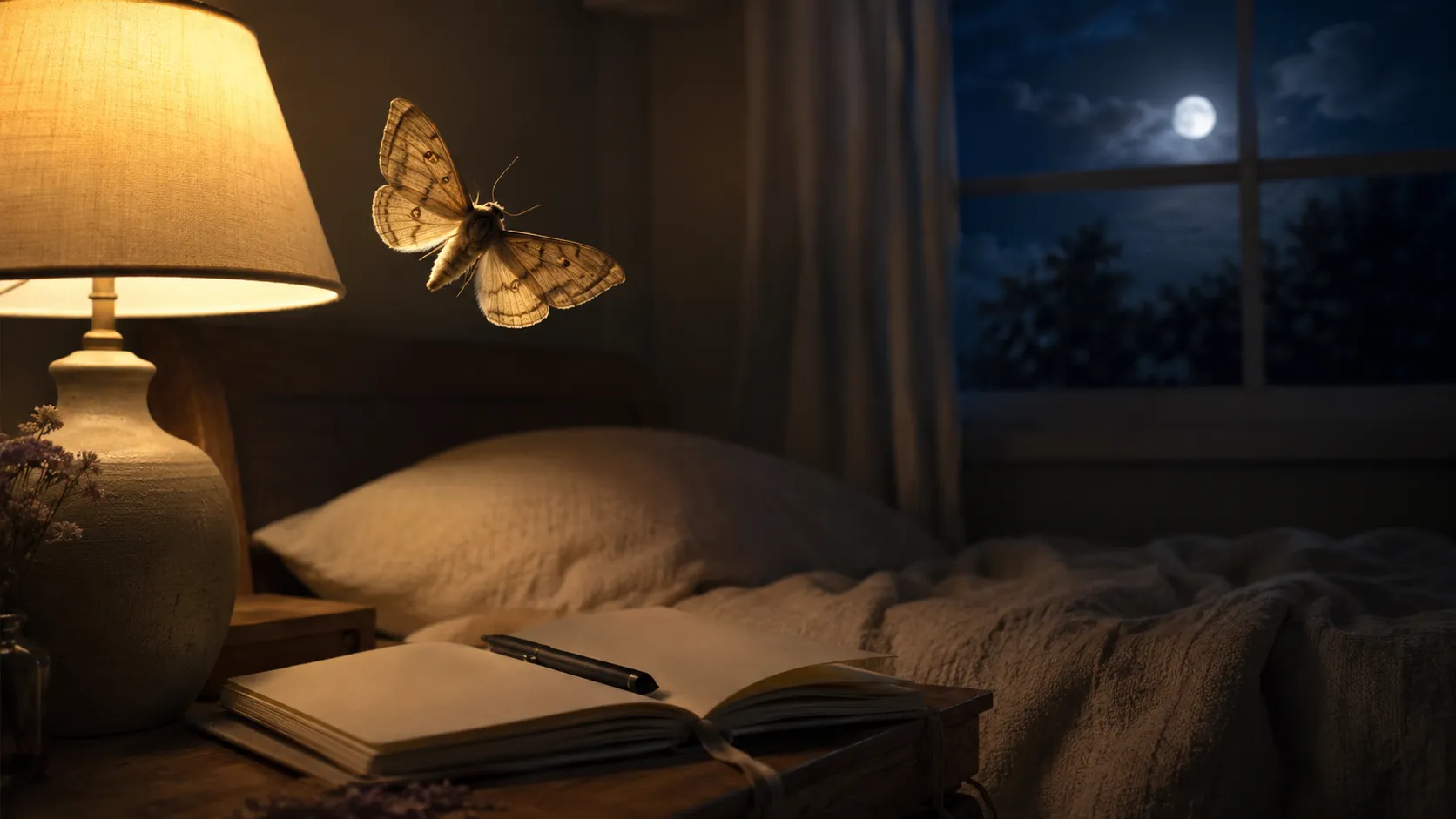
A moth circling a light, resting on your body, or hiding inside a closet can leave a strong impression after you wake. Many people search for the meaning of dreams about moths because the image feels quiet yet unsettling, as though something important remained partly hidden.
A moth dream may relate to personal transformation, persistent worries, misplaced attention, or emotions developing below the surface. However, no scientifically proven dream dictionary assigns one meaning to every moth. Your experiences, beliefs, recent concerns, and emotional response remain essential to understanding the dream.
What Do Dreams About Moths Usually Mean?
Dreams about moths commonly symbolize subtle change, emotional vulnerability, hidden stress, persistent attraction, or something that has been quietly affecting your peace.
Moths are often compared with butterflies, but the two images may communicate different kinds of change. A butterfly is usually associated with visible emergence and outward transformation. A moth moves through darkness and is more likely to suggest a private process that other people cannot yet see.
In Dreams: The Magic of the Night, Kenneth Gray presents dreams as personal communications that deserve thoughtful attention. He emphasizes that the dreamer is often the best interpreter because personal memories, emotions, beliefs, and recent experiences influence the meaning of every image.

Book About Dreams
The Magic of the Night
This book is perfect for anyone seeking to understand the messages and meanings hidden in their dream life. It offers a clear framework for interpreting dreams with real examples and thoughtful insights.
Get the Book- Based on personal dream journals
- Step-by-step interpretations
- Perfect for dream seekers
A moth may feel peaceful to someone who remembers summer evenings around a porch light. It might feel threatening to a person whose clothes were once damaged by moth larvae. Another dreamer may associate it with darkness, spirituality, fragility, or a persistent annoyance.
Before relying on a symbol list, consider using a broader method of interpreting dreams through personal context.
Why Moths in Dreams Symbolize Light and Disorientation
One of the most familiar moth images is a moth repeatedly circling a lamp, candle, window, or flame. This is often described as a symbol of dangerous attraction. While that interpretation may fit some dreams, research on actual insect behavior adds another useful perspective.
A 2024 study published in Nature Communications found that artificial light can interfere with the way flying insects maintain their orientation. Rather than simply flying directly toward the light, insects may turn their backs toward it as though it were the sky. When the light comes from an unnatural direction, this response can cause circling, stalling, or erratic flight. (Why Flying Insects Gather at Artificial Light)
In a dream, a moth circling a light may therefore symbolize disorientation rather than attraction alone. Something may appear bright, urgent, or promising without offering genuine direction.
You might be:
- Seeking approval from someone who gives mixed signals
- Returning to a relationship that repeatedly creates confusion
- Chasing a career goal that looks impressive but feels empty
- Checking messages or social media without gaining reassurance
- Holding tightly to an idea that no longer helps you move forward
Ask yourself, “What light keeps pulling my attention in circles?”
The light source also matters. A candle may represent hope, spirituality, intimacy, or danger. A glowing phone could represent distraction, communication, expectation, or anxiety. Moonlight may feel natural and guiding, while a harsh artificial light may suggest pressure or overstimulation.
Common Dreams About Moths and Their Possible Meanings
| Dream detail | Possible meaning | Question to consider |
|---|---|---|
| Moth circling a lamp | Fixation, confusion, or misplaced attention | What keeps drawing me back without helping me move forward? |
| Moth resting quietly | Patience, sensitivity, or an emerging realization | What becomes clearer when I stop reacting? |
| Moths damaging clothes | Gradual damage to confidence, identity, or security | What has been quietly wearing me down? |
| Giant moth | An issue that has become emotionally significant | What feels larger now than it did before? |
| Dead moth | The end of a pattern, lost energy, or completed change | What am I ready to release? |
These meanings are starting points, not predictions. The interpretation should fit your emotional response and current circumstances without forcing a dramatic conclusion.
A Single Moth Flying
A single moth may represent one thought, concern, desire, or unresolved issue that continues to attract your attention.
Notice whether the moth moves calmly or frantically. A peaceful flight may suggest curiosity, intuition, or gradual change. Erratic movement may indicate confusion, restlessness, or difficulty finding direction.
If you were following the moth, consider where it was leading you. If you were trying to catch or remove it, ask what thought or feeling you have been attempting to control.
A Moth Circling a Flame
A moth circling a flame can represent a goal, relationship, habit, or belief that is both appealing and potentially harmful. The image may reflect the conflict between desire and judgment.
The dream does not necessarily mean you must abandon what you want. It may be asking you to evaluate the emotional cost of pursuing it.
Consider whether the situation gives you direction or merely keeps you stimulated. Healthy guidance tends to produce clarity, while unhealthy fixation often produces repeated uncertainty.
A Moth Landing on You
A moth landing on your hand, face, chest, shoulder, hair, or mouth may suggest that the dream’s message has become personal. The concern is no longer distant or easy to ignore.
The location can provide additional clues:
- A moth on your hands may relate to work, responsibility, service, or something you need to handle.
- A moth on your mouth or throat may reflect withheld words, communication anxiety, or an uncomfortable truth.
- A moth on your chest may connect with grief, love, guilt, pressure, or emotional vulnerability.
- A moth in your hair may represent thoughts that are difficult to remove or organize.
These associations are not strict rules. Begin with what that body area means to you.
For example, imagine a man dreaming of a brown moth resting on his throat. He feels uncomfortable but not frightened. After reflecting on the previous day, he realizes that he has repeatedly postponed an honest conversation with his son. The dream does not predict a family crisis. It may simply show how emotionally close the avoided conversation has become.
Moths Eating Clothes or Stored Objects
Moths damaging clothes, curtains, books, blankets, or stored belongings often suggest slow erosion. Something small may have been ignored until its effects became visible.
In waking life, adult clothes moths do not usually cause fabric damage. The larvae feed on materials such as wool, feathers, fur, hair, and some fabrics, often in dark or protected spaces. (Clothes Moths)
This behavior makes moth damage a meaningful dream image for a problem developing out of sight.
Clothing may represent identity, dignity, protection, profession, social role, or the way you present yourself. If moths eat a coat, uniform, wedding dress, robe, or favorite shirt, ask what part of your identity has been weakened by criticism, shame, comparison, burnout, secrecy, or neglect.
Consider a hypothetical caregiver who dreams of opening a wardrobe and finding holes in a white jacket. Other people praise her for being dependable, but she privately feels exhausted and resentful. The jacket may represent the strong identity she feels pressured to maintain, while the holes reveal the emotional cost of constant self-denial.
A Moth in Your Bedroom
A bedroom often symbolizes rest, privacy, intimacy, vulnerability, or thoughts that appear when public responsibilities fall away.
A moth in the bedroom may represent a concern that follows you into your private life. If it repeatedly interrupts your sleep, circles your phone, or hides near the bed, it may reflect anxiety, overstimulation, relationship tension, or an issue you have not addressed.
The dream does not necessarily predict conflict in your home. It may show that an existing concern is interfering with your ability to rest.
A White Moth
A white moth may suggest peace, sensitivity, grief, spiritual attention, innocence, or a new beginning. The meaning depends heavily on the dream’s mood.
A glowing white moth that leaves you feeling calm may represent comfort or reassurance. A pale moth trapped in a room might instead reflect fragility, emotional confinement, or fear of losing something delicate.
Avoid treating a white moth as automatic proof that a deceased person or spiritual being visited you. When a dream includes a distinct encounter with someone who has died, the characteristics of visitation dreams may offer a more relevant comparison.
A Black Moth
A black moth commonly represents mystery, grief, fear, secrecy, the unknown, or an aspect of yourself that has not been fully understood.
Gray discusses the shadow as the part of the personality containing suppressed or unfamiliar thoughts, feelings, weaknesses, and even unrecognized strengths. Dreams may bring these hidden aspects into awareness so the dreamer can respond more honestly.
A black moth is not automatically an omen of death or spiritual attack. Its emotional tone matters. A calm black moth may invite curiosity, while an aggressive or frightening one may reflect anxiety about an issue you do not yet understand.
A Giant Moth
An unusually large moth amplifies the dream’s central concern. A minor worry may have grown, or an emotional issue may be taking up more mental space than you realized.
Notice what the moth does. A large moth hovering over your bed may represent something disturbing your rest. One blocking a doorway could reflect hesitation about a transition. A giant moth circling a phone might point to the disruptive effect of constant messages, work demands, or digital stimulation.
Many Moths or a Moth Infestation
A large number of moths can symbolize accumulated worries, unfinished responsibilities, intrusive thoughts, or small problems that have become overwhelming.
One moth may represent a single concern. An infestation suggests that several minor issues are consuming time, peace, confidence, or emotional energy.
The dream may be encouraging you to stop treating each concern as insignificant. Write down the problems separately and identify which one requires attention first.
A Dead Moth
A dead moth may symbolize the end of a fixation, the completion of a quiet transformation, emotional exhaustion, disappointment, or an opportunity that no longer feels alive.
Your reaction is important. Relief may indicate readiness to release an unhealthy pattern. Sadness could reflect grief over a lost possibility. Indifference may suggest that a concern once important to you has lost its emotional power.
Are Dreams About Moths Spiritual or Psychological?
Dreams about moths can be understood psychologically, spiritually, or through a combination of both perspectives.
From a psychological viewpoint, dreaming is associated with memory and emotional experience. A 2019 review in Frontiers in Psychology examined research connecting dreaming, REM sleep, emotional reprocessing, and memory. (The Functional Role of Dreaming in Emotional Processes)
A 2024 study in Scientific Reports also found evidence suggesting that dreaming may participate in emotional memory processing, memory consolidation, and next-day emotional regulation. (Evidence of an Active Role of Dreaming in Emotional Memory Processing)
This research does not prove that moths have a specific psychological meaning. It supports the broader idea that dreams may reflect emotionally important memories, worries, relationships, and waking experiences.
From a spiritual perspective, moths may represent seeking light in darkness, discernment, humility, hidden transformation, or the need to examine what guides your attention.
Gray’s approach allows room for spiritual experiences while distinguishing between basic dreams, deeper archetypal dreams, and visions. This distinction helps prevent every vivid image from being treated as prophecy or divine instruction.
Readers considering both explanations may benefit from exploring the role of the subconscious mind and the possible spiritual meaning of vivid dreams.
How to Interpret Dreams About Moths Step by Step
- Record the original dream.
Write down the moth’s color, size, movement, number, location, and distance from you. Do this before searching for meanings because dream details can fade or become less accurate after waking. Keeping a dream journal can help preserve details and reveal connections between dreams and waking experiences. (What Is a Dream Journal Used For?) - Identify the strongest emotion.
Fear, curiosity, peace, sadness, disgust, and wonder suggest different interpretations. A calm black moth carries a different emotional message from a white moth attacking your face. - Examine the setting.
Note whether the moth appeared near a lamp, flame, window, phone, closet, bedroom, basement, or doorway. Ask what that place represents in your present life. - Connect the dream with recent experiences.
Review the previous one to three days. Consider difficult conversations, work pressure, relationship uncertainty, grief, prayer, temptation, creative ideas, and decisions you have delayed. - Look for repetition or hidden damage.
Did the moth keep returning after you removed it? Was it trapped in a loop or damaging something? Repetition may point to a concern that has not been resolved. - Choose the simplest meaning that fits.
Do not immediately assume the dream predicts death, betrayal, curses, or supernatural danger. A grounded interpretation such as “I keep returning to an issue that gives me no clarity” is often more helpful. - Take one reasonable action.
Journal, rest, reduce a distraction, set a boundary, pray, meditate, or have an honest conversation. A dream can encourage reflection, but it should not replace judgment or reliable real-world information.
People who struggle to recall details can use these practical methods for remembering dreams after waking.
When a Moth Dream Deserves Extra Attention
Pay closer attention when the dream repeats, feels unusually vivid, contains a clear message, or continues affecting your mood during the day.
Repeated dreams may return because the underlying emotion or situation remains unresolved. Track what changes from one dream to the next rather than assuming every repetition carries the same message. A guide to the spiritual meaning of recurring dreams may help you identify patterns without relying on fear.
Strong emotional residue can indicate that a dream touched a meaningful concern. However, intensity does not prove that the dream predicts a future event.
Frequent nightmares that disturb sleep, increase anxiety, or connect with traumatic experiences should be discussed with a qualified mental health or sleep professional. Dream reflection can support self-awareness, but it is not a replacement for medical or psychological care.
Conclusion
Dreams about moths often reflect quiet transformation, hidden stress, emotional sensitivity, or attention that has become disoriented. A moth may circle a misleading light, reveal damage developing out of sight, or bring an overlooked feeling closer to awareness.
Neither panic nor immediate dismissal is helpful. Record the dream, examine its details, connect it with waking life, and allow the meaning to develop gradually. Personal context and honest reflection will usually offer more insight than a rigid dream dictionary.
Sources
- Why Flying Insects Gather at Artificial Light, Nature Communications
- The Functional Role of Dreaming in Emotional Processes, Frontiers in Psychology
- Evidence of an Active Role of Dreaming in Emotional Memory Processing, Scientific Reports
- Dreams: What They Are and What They Mean, Cleveland Clinic
- What Is a Dream Journal Used For?, Sleep Foundation
- Clothes Moths, Utah State University Extension
Frequently Asked Questions
What does it mean to dream about a moth flying around a lamp?
A moth circling a lamp may represent fixation, confusion, or repeated attention toward something that appears important but provides little direction. Consider whether a person, goal, habit, or worry keeps drawing you back without creating clarity or progress.
Is dreaming about a moth a spiritual warning from God?
A moth dream may feel spiritually meaningful, particularly when it is vivid, repeated, or morally serious. However, it is not automatic proof of a divine warning, so examine it through prayer, reflection, personal context, and reasonable judgment rather than fear.
What does it mean when moths eat my clothes in a dream?
This image may represent slow damage to confidence, identity, dignity, security, or emotional protection. Ask whether stress, criticism, resentment, comparison, overwork, or neglect has been quietly wearing you down.
Why do I keep dreaming about moths in my bedroom?
Repeated bedroom dreams may relate to rest, privacy, intimacy, vulnerability, or a concern that becomes more noticeable when you are alone. Record the moth’s behavior and review what happened before each dream to identify a possible emotional pattern.
Does a black or white moth have a fixed dream meaning?
No moth color has one scientifically proven dream meaning. Black may suggest mystery, fear, grief, or the unknown, while white may suggest peace, sensitivity, purity, or spiritual attention, but your feelings and personal associations matter more than the color alone.
