

Quick Takeaways
- Dreaming of the devil often points to fear, temptation, guilt, ego, inner conflict, or a part of yourself you would rather not confront.
- The devil’s behavior, your emotional reaction, and what is happening in your waking life matter more than the symbol by itself.
- A frightening devil dream is not automatic proof of evil, spiritual attack, or a prediction of harm, so avoid treating one interpretation as certain.
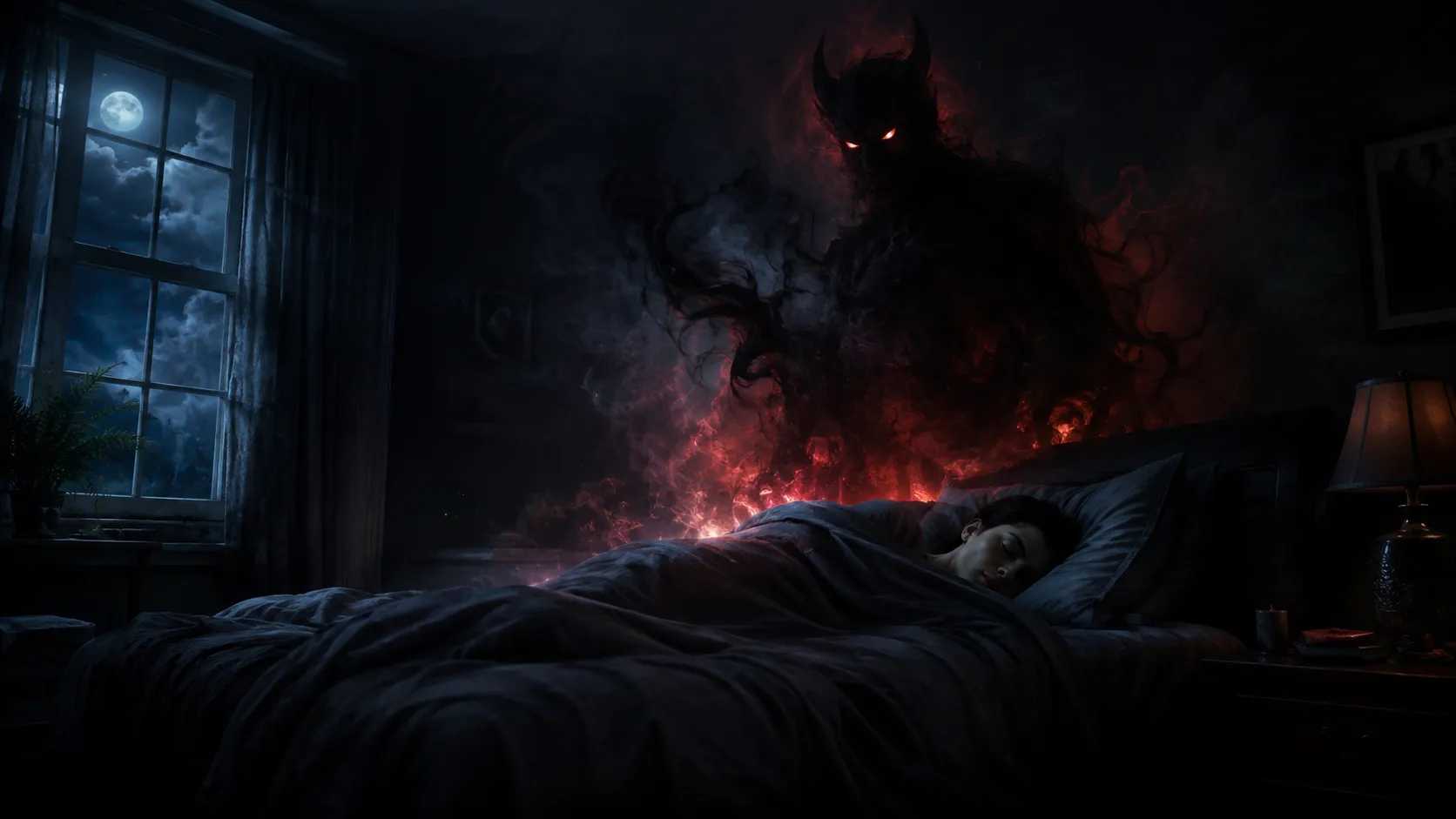
Dreaming of the devil can leave you unsettled long after waking. The image carries centuries of religious, cultural, and psychological meaning, so it is natural to wonder whether the dream was a warning, a spiritual message, or simply the mind giving a frightening form to something difficult.
There is no single interpretation that fits every dreamer. A devil figure may represent temptation to one person, fear to another, and ego or self-deception to someone else. Understanding the dream begins not with the devil itself, but with your relationship to the image and what was happening around it.
What Does Dreaming of the Devil Mean?
In general, dreaming of the devil may symbolize a conflict involving something you consider dangerous, destructive, dishonest, tempting, shameful, or spiritually troubling.
The important word is may.
Dream symbols do not function like fixed vocabulary words. Two people can dream about almost identical devil figures and receive completely different personal meanings from the experience. Someone raised in a strict religious environment may react to the devil primarily through fear of sin or judgment. Someone approaching dreams psychologically may see the figure as an image of the rejected or destructive side of the personality.
Kenneth Gray takes a strongly personal approach to dream interpretation. In Dreams: The Magic of the Night, he emphasizes that the dreamer is usually the person best positioned to understand a dream because personal associations matter. In one of his own devil dreams, Gray interpreted the devil specifically as a symbol of ego and egotism rather than assuming that the figure represented a literal supernatural presence.

Book About Dreams
The Magic of the Night
This book is perfect for anyone seeking to understand the messages and meanings hidden in their dream life. It offers a clear framework for interpreting dreams with real examples and thoughtful insights.
Get the Book- Based on personal dream journals
- Step-by-step interpretations
- Perfect for dream seekers
That distinction is important. The question is not simply, “What does the devil symbolize?” A more useful question is, “What did the devil represent to me in this particular dream?”
For a broader foundation, understanding how dream interpretation works can help you examine symbols in relation to your emotions, associations, and recent experiences.
Common Meanings Behind Devil Dreams
Fear You Have Been Avoiding
Sometimes the devil gives a face to something that feels threatening.
The threat may be external, such as a difficult relationship, financial pressure, conflict at work, or uncertainty about the future. It may also be internal, including fear of failure, rejection, losing control, or becoming someone you do not want to be.
Notice what the devil does. A figure watching from a distance creates a different emotional picture from one chasing you through a house.
Temptation or a Conflict With Your Values
The devil has long been associated with temptation. In a dream, that symbolism can appear when desire and conscience are pulling in different directions.
You might want something while simultaneously believing that pursuing it would violate your values. The conflict does not have to involve dramatic wrongdoing. It could involve dishonesty, jealousy, revenge, unhealthy attention-seeking, or knowingly repeating behavior that causes problems.
In this kind of dream, the devil may personify the voice saying, “Do it anyway.”
Ego, Pride, and the Need for Approval
A devil dream can also turn attention inward.
Gray’s own interpretation provides a useful example. His devil image appeared during a period of self-examination, and he connected it with desires for status, admiration, intelligence, attractiveness, and approval. The dream did not merely frighten him. It drew attention to qualities he believed had become too prominent within his own thinking.
This does not mean every devil dream represents egotism. It shows why personal context matters.
Ask yourself whether you have recently been preoccupied with being right, winning, impressing someone, proving your worth, controlling another person, or protecting your image.
Guilt or Shame
The devil may appear when you are judging yourself harshly.
Perhaps you regret something you said. Maybe you are keeping a secret, struggling with a decision, or carrying guilt about an old event. Religious upbringing can make this symbolism especially powerful because the mind already has a familiar image associated with wrongdoing and punishment.
There is an important difference between useful guilt and destructive shame. Guilt can say, “I did something I should correct.” Shame says, “There is something fundamentally wrong with me.”
A devil dream may reveal either feeling, so pay attention to the language and emotions of the dream.
The Shadow or Rejected Parts of Yourself
In psychological dreamwork, frightening figures can represent qualities a person dislikes, denies, or refuses to acknowledge.
Anger is a simple example. Someone who believes anger is unacceptable may repeatedly suppress it during waking life. In dreams, that rejected emotional energy might appear as a monster, attacker, demon, or devil.
Working with the role of the subconscious mind can help explain why dreams sometimes express difficult material through dramatic symbols rather than straightforward conversations.
The goal is not to identify yourself with the frightening character. It is to ask what quality, emotion, or conflict that character may be carrying for you.
How the Devil Behaves Changes the Dream’s Meaning
The action often provides more information than the character.
| Dream scenario | Possible question to explore |
|---|---|
| The devil is chasing you | What fear, responsibility, or truth are you trying to escape? |
| The devil is watching you | Do you feel judged, guilty, exposed, or monitored? |
| You fight the devil | What destructive behavior, fear, or inner conflict are you resisting? |
| You talk calmly with the devil | Are you becoming conscious of a difficult part of yourself? |
| The devil offers you something | What temptation, compromise, or attractive shortcut are you considering? |
| You defeat or escape the devil | Are you gaining confidence in dealing with a fear or harmful pattern? |
These are starting points, not verdicts.
For example, escaping from the devil may seem automatically positive. Yet if you spend the entire dream running from something that never actually harms you, the dream could also be illustrating avoidance.
Is Dreaming of the Devil a Spiritual Warning?
For spiritually minded dreamers, this is often the most urgent question.
Some people understand disturbing dreams through a religious or spiritual framework. Others interpret the same experience psychologically. These perspectives do not always have to cancel each other out, but they should not be confused with certainty.
A dream containing the devil is not, by itself, evidence that an evil being visited you.
If spiritual interpretation is important to you, consider the full pattern. What happened before the dream? What values were you struggling with? Did the dream encourage fear and obsession, or did it push you into greater honesty, responsibility, prayer, reflection, or compassion?
Readers concerned about the difference between symbolic nightmares and perceived spiritual experiences may find it useful to compare the dream with commonly discussed signs of spiritual attack in dreams. The key is to remain reflective rather than automatically assigning a supernatural cause.
Similarly, exploring warning dreams from God can provide a religious perspective while still allowing each dream to be evaluated individually.
How to Interpret Your Devil Dream Step by Step
1. Write Down What Actually Happened
Record the dream before trying to interpret it.
Include the setting, people, objects, dialogue, colors, movement, and ending. Small details can completely change the meaning.
Avoid immediately rewriting the dream into a conclusion such as, “The devil attacked me because something evil is after me.” Record the experience first. Interpretation comes later.
2. Identify Your Strongest Emotion
Ask what you felt during the dream.
Was it terror, guilt, curiosity, anger, temptation, disgust, confidence, or, strangely enough, peace?
Your emotion often provides the clearest clue. Being terrified of the devil is psychologically different from standing confidently in front of it.
If your dreams frequently feel unusually intense, the discussion of vivid dreams and their spiritual meaning may help you examine why certain dreams remain emotionally powerful after waking.
3. Define What “The Devil” Means to You
Do not begin with someone else’s dream dictionary.
Complete this sentence:
To me, the devil represents ________.
Possible answers might include evil, temptation, fear, rebellion, punishment, manipulation, pride, deception, guilt, spiritual opposition, or something completely different.
Your first honest associations are often more valuable than a generic symbolic definition.
4. Compare the Dream With Recent Waking Life
Look at the previous day and the past several weeks.
Have you been wrestling with a decision? Hiding something? Seeking approval? Feeling tempted? Arguing with someone? Questioning your faith? Becoming angry with yourself?
Gray’s dreamwork repeatedly connects dream scenes with the dreamer’s current attitudes, emotions, choices, and personal growth. That approach keeps interpretation grounded in lived experience rather than treating symbols as isolated predictions.
5. Ask What the Dream Wants You to Notice
The final question should be practical.
Instead of asking only, “Was this dream good or bad?” ask:
- What am I being shown?
- What am I refusing to acknowledge?
- What needs to change?
- What fear deserves closer examination?
- What choice am I making?
- What part of myself needs honesty rather than judgment?
A biblical dream symbols dictionary can provide additional symbolic possibilities, especially for religious imagery, but personal context should still guide the final interpretation.
When Devil Dreams Keep Coming Back
A recurring devil dream deserves attention because repetition often means the underlying concern remains emotionally active.
Look for what stays the same. Is the devil always chasing you? Does it appear in the same building? Are you repeatedly unable to speak, move, or escape?
Then notice what changes. Perhaps you hide in the first dream, confront the figure months later, and eventually speak to it. Changes like these may reflect a changing relationship with the fear or conflict represented by the dream.
Repeated disturbing dreams can also occur during periods of severe stress or after frightening experiences. If nightmares regularly disrupt your sleep, cause significant daytime distress, or are connected with trauma, consider discussing them with a qualified mental health professional. Spiritual reflection and professional support do not have to be mutually exclusive.
What Dreaming of the Devil May Ultimately Be Showing You
Dreaming of the devil can feel ominous, but frightening imagery does not automatically carry a frightening message.
The figure may represent temptation, fear, guilt, ego, suppressed anger, a conflict of values, or another deeply personal concern. For spiritually oriented dreamers, it may also become part of a larger examination of faith and conscience. What matters most is how the symbol operates inside your own dream.
Instead of fearing the image immediately, become curious about it. Record the dream, examine your emotional response, consider what is happening in waking life, and ask what the experience brings into awareness.
Sometimes the most disturbing dream characters appear not simply to frighten us, but to make something difficult impossible to ignore.
Frequently Asked Questions
Does dreaming of the devil mean something bad will happen?
No. Dreaming of the devil does not reliably predict that a harmful event is coming. The figure may instead symbolize fear, temptation, guilt, conflict, or another issue already present in your emotional or spiritual life.
What does it mean when the devil chases you in a dream?
Being chased by the devil may represent an issue you are avoiding, especially something you regard as threatening, shameful, or difficult to confront. Consider what you were running from emotionally in waking life and whether the dream resembles a pattern of avoidance.
What does it mean if I fight the devil in my dream?
Fighting the devil may symbolize resistance to temptation, fear, destructive behavior, self-criticism, or another powerful inner conflict. Your feelings during the fight matter, particularly whether you felt helpless, angry, determined, or confident.
Is seeing the devil in a dream a sign of spiritual attack?
Not necessarily. Some religious traditions interpret certain disturbing dreams spiritually, but the presence of a devil figure alone cannot establish that a spiritual attack occurred. Consider psychological, emotional, personal, and spiritual explanations before reaching a firm conclusion.
Why do I keep dreaming of the devil repeatedly?
Recurring devil dreams may indicate that the fear, conflict, belief, or behavior represented by the figure remains unresolved. Record each version of the dream and compare the details, because changes in your actions and emotions may show how your relationship with the underlying issue is developing.
