

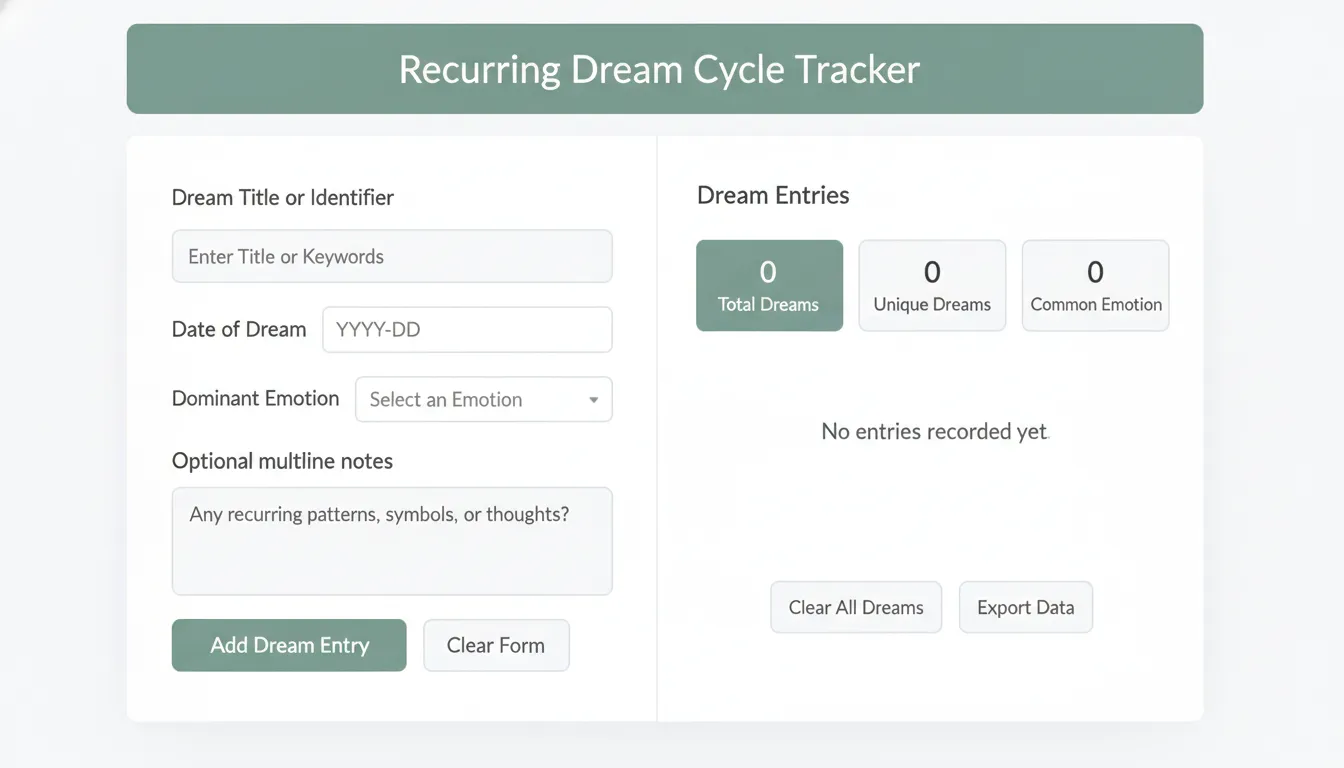
Recurring dreams can feel unsettling, confusing, or even intrusive. Many people experience the same dream theme over and over and wonder why it keeps returning. The Recurring Dream Cycle Tracker was created to answer a different question than most dream tools ask.
Instead of asking What does this dream mean?, this tool asks:
What pattern is trying to be noticed?
This page explains how the tool works, why recurring dreams happen, what research says about them, and how tracking cycles can deepen self-awareness without forcing interpretation.
What Is a Recurring Dream Cycle Tracker?
A Recurring Dream Cycle Tracker is a simple awareness-based tool that helps you:
- Log repeated dreams over time
- Observe emotional patterns connected to those dreams
- Notice frequency, spacing, and changes
- Identify cycles rather than symbols
It does not interpret dreams.
Meaning is not assigned.
It does not rely on dream dictionaries.
Instead, it supports clarity through observation.
Track repeated dreams to notice timing, emotions, and recurring patterns.

Book About Dreams
The Magic of the Night
This book is perfect for anyone seeking to understand the messages and meanings hidden in their dream life. It offers a clear framework for interpreting dreams with real examples and thoughtful insights.
Get the Book- Based on personal dream journals
- Step-by-step interpretations
- Perfect for dream seekers
How the Recurring Dream Cycle Tracker Works
The tracker is intentionally simple. Complexity can distract from noticing.
What You Log
- A dream title or identifier
- The date the dream occurred
- The dominant emotion felt
- You can also export it
That is all.
Brief entries
Symbol-free
No explanations required.
What the Tool Shows You
Over time, the tracker reveals:
- Repetition frequency
- Emotional consistency or change
- Clusters around specific time periods
- Gaps when the dream disappears
This information allows reflection without interpretation.
Why Recurring Dreams Matter
Recurring dreams are not rare. Research consistently shows that repeating dreams are a common human experience.
Key Statistics
- Around 60–75% of adults report having at least one recurring dream in their lifetime
- Approximately 35% of adults experience recurring dreams during periods of stress or life transition
- Children report recurring dreams more often than adults, but frequency usually decreases with age
Sources:
- American Academy of Sleep Medicine
- International Association for the Study of Dreams
- American Psychological Association
These numbers suggest recurring dreams are not random events. They tend to appear during times when attention, emotion, or awareness is under strain.
Why Tracking Is More Useful Than Interpreting
Most dream tools focus on meaning first. This often creates dependency, confusion, or oversimplification.
Tracking works differently.
When you track recurring dreams, you focus on:
- When the dream appears
- How often does it returns
- What emotion dominates
- How the experience changes over time
Patterns become visible without being forced.
Awareness grows naturally.
The Difference Between Recurring Dreams and Repeating Themes
Not all repeated dreams are identical.
The tracker helps you distinguish between:
- Recurring dreams
The same or very similar dream appears multiple times. - Repeating themes
Different dreams share the same emotional or situational tone.
This distinction matters. Awareness grows faster when patterns are seen clearly.
Emotional Cycles and Recurring Dreams
Studies in sleep psychology suggest recurring dreams often carry a strong emotional charge rather than a fixed story.
Common emotions reported in recurring dreams include:
- Fear
- Anxiety
- Frustration
- Curiosity
- Helplessness
- Urgency
Tracking emotion instead of imagery helps answer a more useful question:
Is the emotional tone changing over time?
If fear softens into curiosity, awareness is shifting even if the dream remains.
Why Recurring Dreams Often Stop on Their Own
One of the most interesting observations from dream research is that recurring dreams often stop once something is consciously noticed.
This does not require interpretation.
It requires attention.
According to cognitive and psychodynamic studies, recurring dreams decrease when:
- Stress levels change
- Emotional conflicts resolve
- Awareness increases
- Life direction shifts
Sources:
- American Psychological Association
- Sleep Foundation
- Journal of Sleep Research
Tracking creates the conditions for noticing.
How to Use the Tracker Effectively
To get the most value from the Recurring Dream Cycle Tracker, follow these simple guidelines.
1. Be Consistent, Not Perfect
Log dreams when you remember them. Gaps are informative too.
2. Keep Titles Simple
Use short identifiers like:
- “Endless hallway”
- “Missed train”
- “Old house”
3. Focus on Emotion
Emotion is often more stable than imagery.
4. Review Monthly
Patterns appear over weeks, not days.
What This Tool Is Not
It is important to be clear about boundaries.
The Recurring Dream Cycle Tracker:
- Does not predict outcomes
- Does not diagnose conditions
- Does not replace professional support
- Does not provide spiritual claims
It is a self-awareness tool, not an authority.
The Role of Awareness in Dream Cycles
Many dream researchers agree on one point: dreams often repeat when attention is fragmented or overwhelmed.
Tracking restores attention.
By observing without forcing conclusions, the mind often resolves patterns naturally.
This aligns with awareness-based approaches used in:
- Mindfulness psychology
- Somatic therapy
- Cognitive reflection practices
Sources:
- Mindfulness-Based Cognitive Therapy research
- Harvard Medical School sleep studies
Common Mistakes When Working With Recurring Dreams
Avoid these traps:
- Trying to “solve” the dream
- Searching for fixed meanings
- Ignoring emotional shifts
- Over-logging details
- Relying on one explanation
The tracker helps prevent these by keeping focus on cycles, not conclusions.
Frequently Asked Questions
What is a recurring dream cycle?
A recurring dream cycle is a pattern where similar dreams repeat over time, often connected by emotion or situation rather than exact imagery.
Do recurring dreams always mean something is wrong?
No. Recurring dreams often reflect attention, stress, or life transitions. They are common and not automatically negative.
How long should I track recurring dreams?
At least four to six weeks. Cycles often appear over longer periods rather than immediately.
Can tracking make recurring dreams stop?
Many people report that increased awareness reduces repetition. Tracking supports noticing without force.
Is this tool a dream interpreter?
No. The Recurring Dream Cycle Tracker does not interpret or assign meaning to dreams.
Sources and References
- American Psychological Association – Dream research and emotional processing
- American Academy of Sleep Medicine – Sleep and dream studies
- International Association for the Study of Dreams – Recurring dream research
- Sleep Foundation – Stress and dream frequency
- Journal of Sleep Research – Emotional continuity in dreams
Final Thought
Recurring dreams are not puzzles to solve. They are patterns to notice.
The Recurring Dream Cycle Tracker offers a grounded, respectful way to observe without guessing, explain without forcing, and grow awareness naturally.
If you already use a dream interpreter, this tool complements it by doing what interpretation cannot:
showing you the rhythm behind repetition.
Use it slowly. Let patterns speak.
