

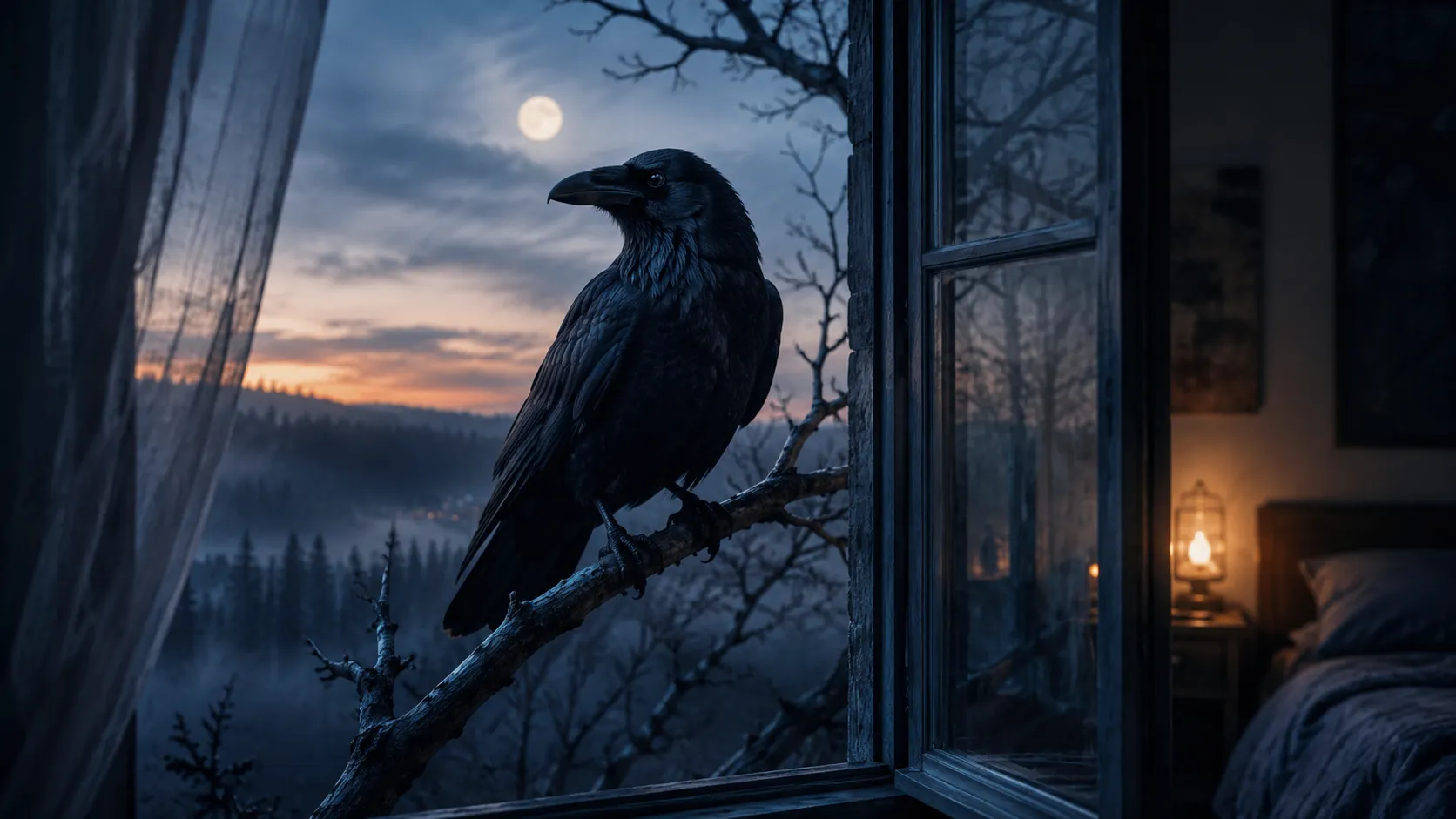
Explore the bird’s behavior, your emotions, and the difference between symbolism and prediction.
A crow watching from a windowsill can leave a stronger impression than everything else in a dream. A crow in a dream has no single fixed meaning: the bird may bring up associations with fear, curiosity, change, intelligence, or companionship, depending on your experience. A threatening crow and a friendly one invite different questions, even when they look identical. Before searching for an omen, consider what happened and how you felt. That combination offers a useful starting point for exploring the dream without turning an unsettling image into a prediction about your future.
What Shapes Crow in Dream Meaning?
Start with three details: your associations with crows, the bird’s actions, and your response.
Someone who enjoys watching crows outside their home may experience the bird as familiar company. Another person, remembering a frightening film or a family superstition, may find the same image disturbing. Neither reaction establishes a universal meaning.
The International Association for the Study of Dreams recommends exploring the dreamer’s own images, feelings, and associations. Its ethics statement recognizes the dreamer as the person who decides the dream’s significance and allows for multiple meanings. asdreams.org
Consider these questions before choosing an interpretation:
- What did the crow actually do?
- Did your feelings change during the encounter?
- What personal memory does the bird bring to mind?
- What happened immediately before and after it appeared?
The surrounding story matters. A crow outside your childhood home belongs to a different emotional setting than one sitting peacefully beside you in an unfamiliar garden.
For a broader starting point, explore these approaches to dream interpretation. Use possible meanings to generate questions, then compare those questions with your own circumstances.

Book About Dreams
This book is perfect for anyone seeking to understand the messages and meanings hidden in their dream life. It offers a clear framework for interpreting dreams with real examples and thoughtful insights.
Get the Book- Based on personal dream journals
- Step-by-step interpretations
- Perfect for dream seekers
Why Might a Crow Appear in Your Dream?
Sometimes the simplest explanation deserves attention first: you recently encountered one.
You might have noticed crows on your commute, watched a bird video, read a story featuring a raven, or heard someone describe crows as ominous. Ask whether any recent encounter supplied the image before assuming it carries a deeper message.
The National Institute of Neurological Disorders and Stroke explains that daytime events can enter dreams. It also notes that dreaming’s exact purpose remains unknown, although it may help with emotional processing. Stress and anxiety are associated with more frightening dreams. ninds.nih.gov
That research provides context for dreaming generally. It does not establish a scientific translation for a crow.
If you are interested in the broader distinction between sleep research and interpretation, this scientific and psychological guide provides a related reading path.
Could the crow represent intelligence or resourcefulness?
Intelligence is one possible personal association. Research on New Caledonian crows documents their use of tools to obtain food, including sticks used to extract grubs. That is a finding about a particular crow species, rather than evidence about dream symbolism. Cornell Chronicle
If you already associate crows with cleverness, a dream featuring one solving a problem might prompt you to consider your own ingenuity. Perhaps you are working with limited resources or looking for a different approach to a difficult task.
The useful question is specific: “Where could I try another strategy?” Calling the dream a guaranteed sign of exceptional wisdom would go beyond what the image can establish.
What Was the Crow Doing?
The following table offers reflection prompts, not a dictionary of proven meanings. Choose the questions that fit the dream’s actual details.
| Dream detail | Possible angle to explore | A useful question |
|---|---|---|
| A crow watches quietly | Attention, curiosity, or feeling observed | Did its attention feel reassuring or uncomfortable? |
| A crow chases or pecks you | Conflict, pressure, or vulnerability | What about the encounter felt threatening? |
| A crow accepts food | Trust, care, or connection | How did you feel when it approached? |
| A crow enters your home | Welcome, disruption, or privacy | Did you want it inside? |
| Several crows gather | Company, noise, or feeling outnumbered | Was the group peaceful or overwhelming? |
| A crow flies away | Separation, relief, or an unfinished encounter | Did you want it to stay? |
| An injured crow needs help | Concern, helplessness, or responsibility | What did helping it require of you? |
Notice how one detail can support several possibilities. Interpretation becomes more useful when you can explain why a particular possibility fits.
A crow attacking or chasing you
Begin with the experience of being attacked. Were you cornered, embarrassed, angry, or able to escape? Was the crow the only threat, or did other people participate?
If you are currently facing criticism, the dream could offer an image through which to examine that feeling. If you recently watched an aggressive bird encounter, the connection may be more straightforward.
Avoid assigning the crow to a specific person without supporting waking evidence. A dream about an attack does not establish that a colleague or relative intends to harm you.
A friendly crow or one landing on you
A peaceful encounter creates different possibilities. Feeding a crow, carrying it, or allowing it to perch on your shoulder might invite reflection on trust and closeness.
Your reaction remains essential. A bird landing on your arm could feel delightful, intrusive, or frightening. Ask whether you welcomed the contact and whether that feeling resembles any current relationship.
There is also room for an uncomplicated answer: you like crows, and the dream gave you an enjoyable encounter.
A crow inside your house
Rather than treating every house as the same symbol, identify whose home it was and what that place means to you.
A crow entering your present home may raise questions about privacy or unexpected visitors. In a childhood home, the scene might bring up family memories. If you opened the window deliberately, your role differs from a dream in which the bird forced its way inside.
Record what happened before deciding the crow represents an intrusion.
A dead or injured crow
A dead bird can be upsetting, particularly when you care about animals. Possible personal associations include loss, vulnerability, a remembered encounter, or concern about something ending.
An injured crow adds another question: what did you do? Trying to rescue it, being unable to reach it, or walking away creates different stories.
You can explore those reactions without treating the bird’s condition as a forecast of someone else’s health or death.
Does a Black Crow in a Dream Mean Something Bad?
Black feathers alone cannot tell you whether a dream is positive or negative. American Crows and Common Ravens are both black birds, as the Cornell Lab of Ornithology’s identification guide explains. A dark bird may simply reflect its ordinary appearance. Bird Academy • The Cornell Lab
If black has a strong personal association for you, explore that separately. Does it remind you of mourning clothes, a favorite coat, nighttime, elegance, or something else? Several associations can coexist.
Apply the same approach to an unusual white crow. Its unexpected appearance might be what made it memorable. Ask whether it felt beautiful, unfamiliar, fragile, or startling, rather than assigning white an automatic spiritual meaning.
Color is one detail within the scene. The crow’s behavior, setting, and your response provide the rest.
What Could a Crow Dream Mean Spiritually?
A spiritual reading begins with your beliefs and experiences. You might experience a crow as a reminder to pay attention, reflect on change, or approach an unfamiliar situation with curiosity. Those are interpretive possibilities, not established properties of crow dreams.
Keep the interpretation connected to something you can examine. For example:
- If the crow reminded you of a deceased relative, consider which memory or feeling arose.
- If its appearance felt encouraging, identify what you felt encouraged to do.
- If the dream seemed like a warning, describe the concern clearly and check it against waking facts.
Prayer, meditation, or quiet reflection may help you explore the experience within your faith. The dream’s emotional force, however, cannot independently verify a supernatural source.
Readers exploring dreams associated with bereavement may find the discussion of visitation dreams and remembrance relevant.
Kenneth Gray’s Dreams: The Magic of the Night takes a personal, spiritually oriented approach to dream exploration. In its “My Perspective” section, Gray emphasizes the dreamer’s role in interpretation; elsewhere, he describes using symbolic associations while giving personal intuition the final say. These are features of his approach, rather than scientific findings.
Book About Dreams
This book is perfect for anyone seeking to understand the messages and meanings hidden in their dream life. It offers a clear framework for interpreting dreams with real examples and thoughtful insights.
Get the Book- Based on personal dream journals
- Step-by-step interpretations
- Perfect for dream seekers
What Does the Bible Say About Crows and Ravens?
A biblical discussion requires care because references to birds are not automatically instructions for interpreting dreams.
In Luke 12:24, Jesus uses birds to illustrate God’s care and human worth. Many English translations say “ravens,” while some, including the Good News Translation, use “crows.” The passage addresses provision and worry; it does not describe a crow dream. Bible Gateway
In 1 Kings 17:4–6, ravens bring food to Elijah while he stays beside a brook. Again, the birds appear within a particular narrative rather than a universal dream code. Bible Gateway
A Christian reader might draw a personal connection between these passages and themes of care or unexpected help. That is a devotional interpretation applied to the dream. The cited passages themselves do not establish that dreaming of a crow predicts provision, death, betrayal, or spiritual attack.
When consulting a biblical dream symbols dictionary, distinguish the scriptural passage from the interpretation built around it. Ask what the verse says in its original setting before applying it to your experience.
A Worked Example: Separate the Dream From Your First Assumption
Consider this hypothetical dream:
You are packing boxes before moving. A crow sits on the open window, watches you, and flies away when you reach for the last box. You feel sad rather than frightened.
An immediate interpretation might be, “The crow means something bad will happen.” Yet that conclusion overlooks the dream’s setting and emotion.
A more careful reading starts with what is present:
- The action: You are preparing to leave.
- The setting: A familiar home is being emptied.
- The emotion: Sadness accompanies the crow’s departure.
One possible interpretation is that the scene expresses feelings about leaving a familiar place. Another is that the crow recalls a bird you regularly watched from that window. You might also associate it with a person who shared that home.
None of these possibilities is automatically correct. Compare them with your memories.
Now change one detail: suppose you feel relieved when the crow leaves. The question changes too. You might explore what you are glad to leave behind.
This exercise shows why the emotion and sequence deserve as much attention as the bird.
How to Explore Your Crow Dream Without Forcing a Meaning
Try the following process while the memory is fresh.
- Write the scene before interpreting it. Describe the location, people, bird, and sequence. Keep observations separate from conclusions.
- Name your feelings precisely. “Uneasy because it stared at me” gives you more to work with than “bad.”
- List your own associations. Include ordinary experiences, stories, family beliefs, and memories.
- Check recent exposure. Note whether you saw a crow, watched related footage, or discussed birds recently.
- Consider two plausible explanations. Compare them with the whole scene instead of choosing whichever sounds most dramatic.
- Choose a proportionate next step. You might journal about a transition, acknowledge grief, or address an existing concern using waking evidence.
For example, a dream that brings an unfinished conversation to mind could prompt you to consider whether that conversation needs attention. It does not tell you what the other person thinks.
If the scene is difficult to recall, these ways to remember dreams offer a related starting point.
An interpretation can remain tentative. You do not need to find a hidden message in every image for the dream to be interesting or emotionally meaningful.
Frequently Asked Questions
What does dreaming of two or three crows mean?
The number has no established universal dream meaning. Ask whether the birds acted together, behaved differently, or reminded you of a particular group. If the number has personal significance, record that association without treating it as a prediction.
What does it mean when a crow talks to you in a dream?
Write down the words you remember and distinguish them from anything you added after waking. Consider whether they resemble a recent conversation, worry, or familiar expression. A talking crow can be explored as part of the dream’s story without assuming its speech carries external authority.
Can a crow dream mean a deceased loved one visited me?
You may understand it that way within your spiritual beliefs, especially if the bird evokes a strong memory of that person. The dream itself cannot verify contact with the deceased. You can still reflect on the comfort, grief, or affection the experience brought up.
Why do I keep dreaming about crows when I rarely see them?
Check for repeated exposure through books, films, conversations, or your own attention to earlier dreams. Compare the recurring scenes and emotions rather than assuming the bird always represents the same thing. A crow that first frightened you and later approached peacefully gives you a different pattern to explore.
Should I make an important decision because of a crow dream?
Use the dream as a prompt to examine your feelings, then assess the decision using facts, consequences, and relevant advice. A vivid image may draw attention to a concern you want to explore. It cannot establish what another person intends or guarantee how a decision will turn out.
